
By Michael Burke
Alan Milburn’s report ‘Young people and work: interim report’ has received widespread coverage and considerable acclaim.
But this praise is misplaced. It represents the mistaken acceptance of a string of assertions on NEETs (people Not in Education, Employment or Training) that are not supported by Milburn’s own evidence. These false assertions matter because they are paving the way for a severe changes in the system of benefits for young people, which will have far-reaching consequences for them and for society in general.
This article will argue the following points:
- The number of NEETs is not out of control, it is below the 25yr average (when records began)
- The number has not been rising until very recently; it has been stable at a low level
- Nearly 50% of NEETs don’t claim benefits, so the genuine problem of lack of work has nothing to do with benefits
- Another 20% have such severe disabilities that even DWP doesn’t expect them to work
- This means that 2/3rds of all NEETS cannot be affected by benefit cuts, yet this is the aim of the report
- Contrary to Milburn’s assertions, the Low Pay Commission has examined the impact of the higher minimum wage (and 85% of under-25s get more than that) and found no linkage.
- The most recent data, produced since the report, does show a rise (still well within pre-existing ranges). But this is evidence of a change in objective circumstances for youth employment and training, not any adverse change in pay, or benefits.
Chart 1. The rate of NEETs in the British economy
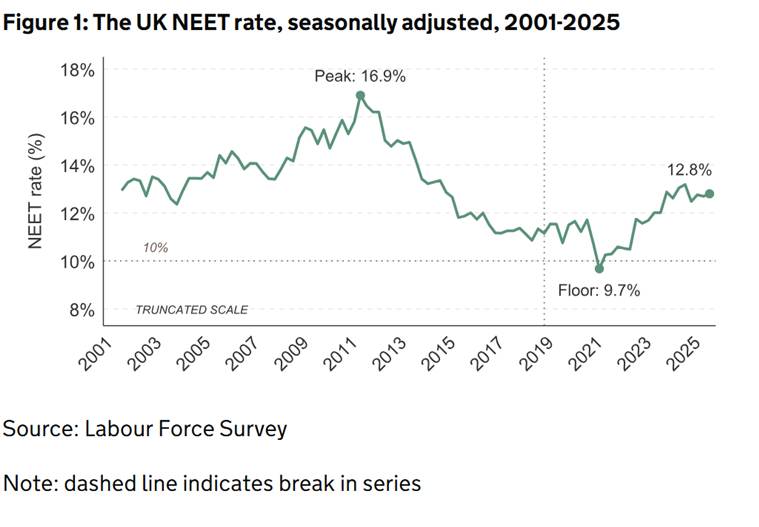
Fig.1 above shows the proportion of young people who are NEETs. The proportion is a more meaningful figure than recent headline-grabbing reports that the total has topped 1 million, as the number of young people has been growing over time.
What the very first chart of the report shows is that there is no new crisis of NEETs at all. If we disregard the exceptional period of lockdown the low-point for the proportion of NEETs is 11%. The high is 16.9%. The 12.8% in Milburn’s report is very far from a surge. It is actually below the long-term average.
There is another feature of the chart which is worth discussion. Milburn argues that he does not want a ‘blame game’, so barely discusses causes of the NEETs problem at all. But, accepting that there is a concern with any high level of people who could be in work, education or training and are not, then it is a glaring error to avoid discussion of causes.
Fig. 1 shows a sustained fall in the proportion of NEETs from 2011 until progress was halted in 2019. The report has nothing to say about this fall, which might be of interest to anyone addressing the issue.
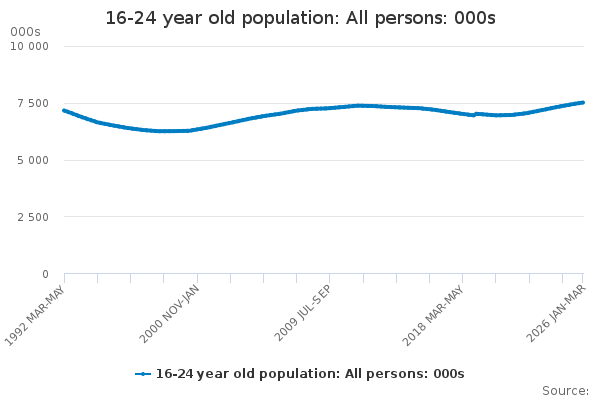
Chart 2. Population of 16 to 20 year olds
Source: ONS
One of the key factors producing a rise in NEETS is simply the rise in their total, without the employment or training and education to harness their potential. Between June 2011 and June 2020 youth numbers fell by 429,000, which largely accounts for the earlier fall.
Currently there are 7.5 million 16-24 year olds in Britain. On known demographics, the Office for National Statistics projects this total will rise by 100,000 a year over the next 3 years and will then begin a gradual decline. This poses a challenge in the short-term, but the current panic over the number of NEETs is false. It is firstly a demographic blip.
However, Milburn’s report does not treat it as such, instead preferring to categorise it as a major structural problem requiring urgent remedy. But a central part of the recommended policy response will be reduced welfare available to 16-24 year olds, both in terms of eligibility for benefits and the level of support provided by those benefits. Welfare costs are cited early in the foreword to the report and mentioned 53 times in total.
But it is precisely in the area of benefits that Milburn’s report gets itself into the biggest muddle. Chart 3. Below shows NEETs by benefits status and is also taken from the Milburn report.
Chart 3. NEET young people by benefit claimant status
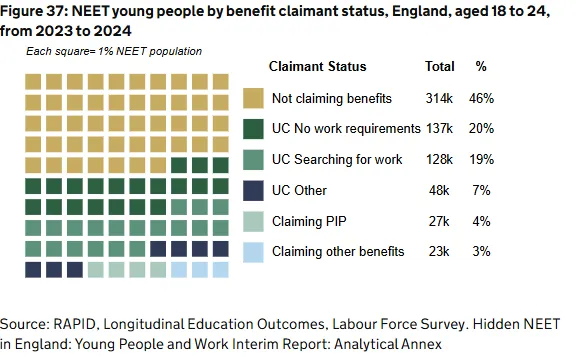
The first point to note is that 46% or nearly half of all NEETs are not in receipt of any benefits at all. Therefore, any policy claiming to tackle the issue of NEETs that relies primarily on benefit cuts, as Milburn suggests, is likely to fail given that any cuts will not affect nearly half of all NEETs.
That likelihood gets closer to a certainty once the second category of NEETs is considered. 20% of them have no DWP requirement to search for work at all. These are mainly people who are so severely disabled that they are exempt from searching for work. There are other categories of people under the same heading, such as women in the later stages of pregnancy.
Taking these two categories together, people not receiving benefits and those receiving benefits without a requirement look for work, amounts to 66% of all NEETs. So, two-thirds of all NEETs cannot directly be affected by any cuts to benefits in any way.
On another interpretation, Milburn intends to propose benefits cuts for young people regardless of these facts. In that case the panic over NEETs would simply be a pretext for cuts to benefits for all young people, primarily and overwhelmingly who are not NEETs.
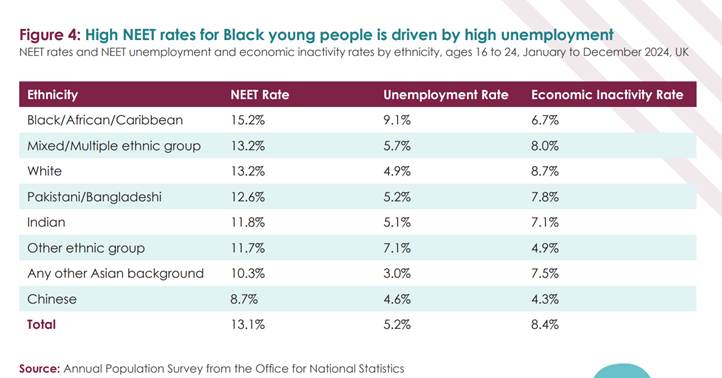
One key consequence of any attack on young people in general or NEETs in particular is that this would fall disproportionately on young Black people. This is shown in Chart 4 below.
Chart 4. NEETs rate by ethnicity
Source: Youth Futures Foundation
In summary, the evidence from the Milburn report itself is that the panic over NEETs is spurious. Milburn’s conclusions do not follow from the evidence at all. Instead, the aim to generate a panic over NEETs to launch a widespread attack on the support provided to young people in general. There is no attempt to address the causes of young people being denied education, employment or training to improve their opportunities and outcomes.
Recent Comments